THE CHALLENGE
Land value sits underneath many important decisions in the built environment. Real estate teams use it to understand markets and investment opportunities. Public agencies rely on it for taxation, planning, and infrastructure decisions. Conservation groups use it to assess land protection opportunities and trade-offs.
But before this project, the U.S. did not have a reliable, high-resolution land value dataset.
County tax assessments vary widely in quality, coverage, and methodology. Land-only sales are more directly tied to market value, but they are often fragmented and difficult to match to real locations at scale.
Without a consistent parcel framework, it was nearly impossible to compare land values across regions or build a national model with enough geographic detail to support serious analysis.
Boston University’s Places Lab needed a way to connect millions of land-only sales to real-world locations and model land value across the country with a consistent spatial foundation.
THE SOLUTION
Through Regrid’s Data With Purpose program, Boston University researchers used Regrid’s parcel dataset as the national spatial framework for the project.
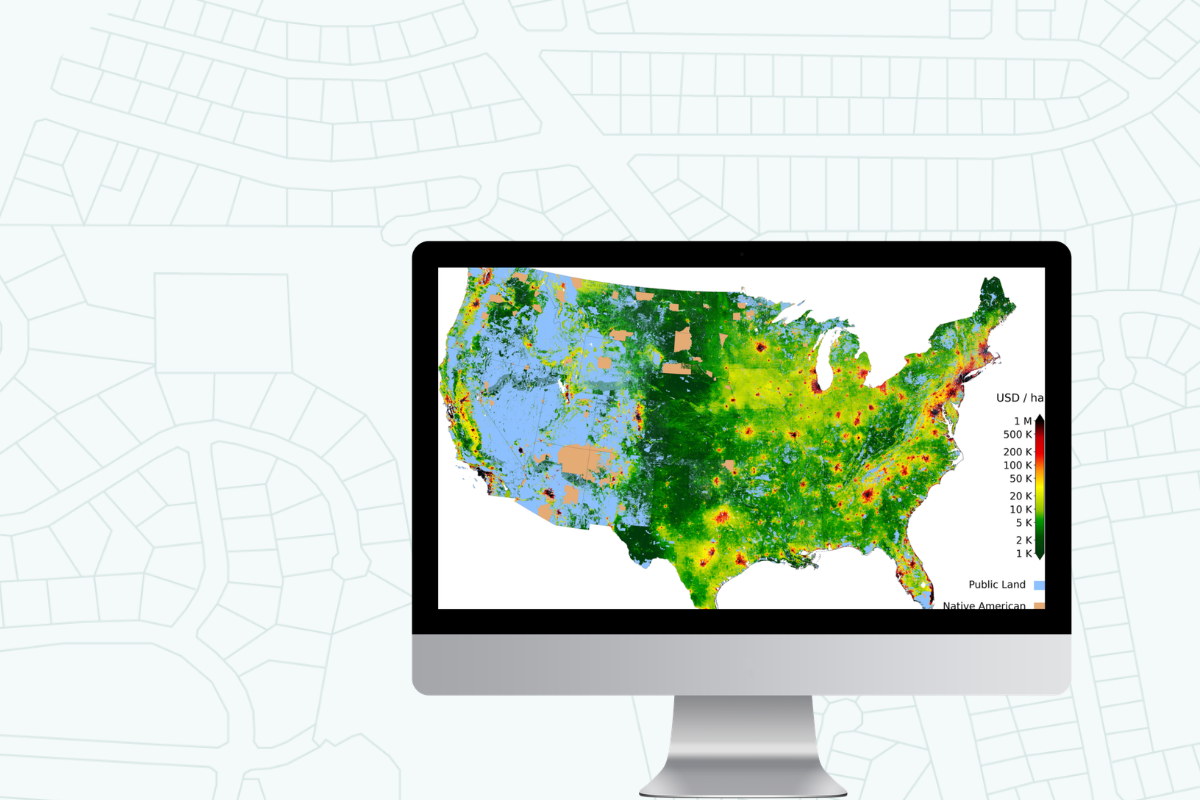
The team compiled more than 4 million verified land-only sales and trained a machine learning model to predict per-square-meter land value across the contiguous United States.
Regrid’s parcel data made that work technically feasible by providing consistent geometry, standardized structure, and nationwide coverage. With a unified parcel fabric in place, the research team could geolocate sales, match records to real-world parcels, and support the spatial modeling pipeline needed to build a national land value model.
THE RESULTS
The resulting model outperformed traditional approaches, achieving twice the accuracy of tax assessment-based estimates.
The model is open source and fully documented, with code, methods, and data made available through GitHub. It is also distributed as GIS-ready raster tiles through Google Cloud and visualized on FMV-USA.
By anchoring valuation to real sales and consistent spatial units, the model creates a more transparent baseline for comparing land values across regions. That matters in dense urban cores, where small differences in location can carry major price implications. It also matters in rural and conservation areas, where traditional valuation data may be sparse or inconsistent.
For commercial teams, this project shows how standardized parcel data can support better market intelligence, valuation modeling, investment analysis, and location-based decision-making.
For public-sector and research teams, it creates a reusable foundation for studying land policy, housing affordability, infrastructure investment, and the distributional effects of taxation.