THE CHALLENGE
America’s farmland is under growing pressure from urban sprawl and low-density development.
As working lands are converted, rural economies become more fragmented, food systems become more vulnerable, and opportunities for climate resilience can be lost. For planners, policymakers, and land conservation groups, the question is not only how much farmland is at risk. It is which properties are most vulnerable and where protection efforts should be focused.
Traditional land forecasts can show general development trends, but they often lack the detail needed for local action. Without parcel-level insight, officials and advocates may struggle to understand what to save, where to intervene, and how different growth strategies could change the future of farmland loss.
To make the research useful for local decisions, the team needed to show development pressure at the property level, not just across broad regions.
THE SOLUTION
Regrid provided consistent property boundaries, land use, and ownership information across 150 million parcels. This gave the team a standardized framework for modeling development risk at the property level.
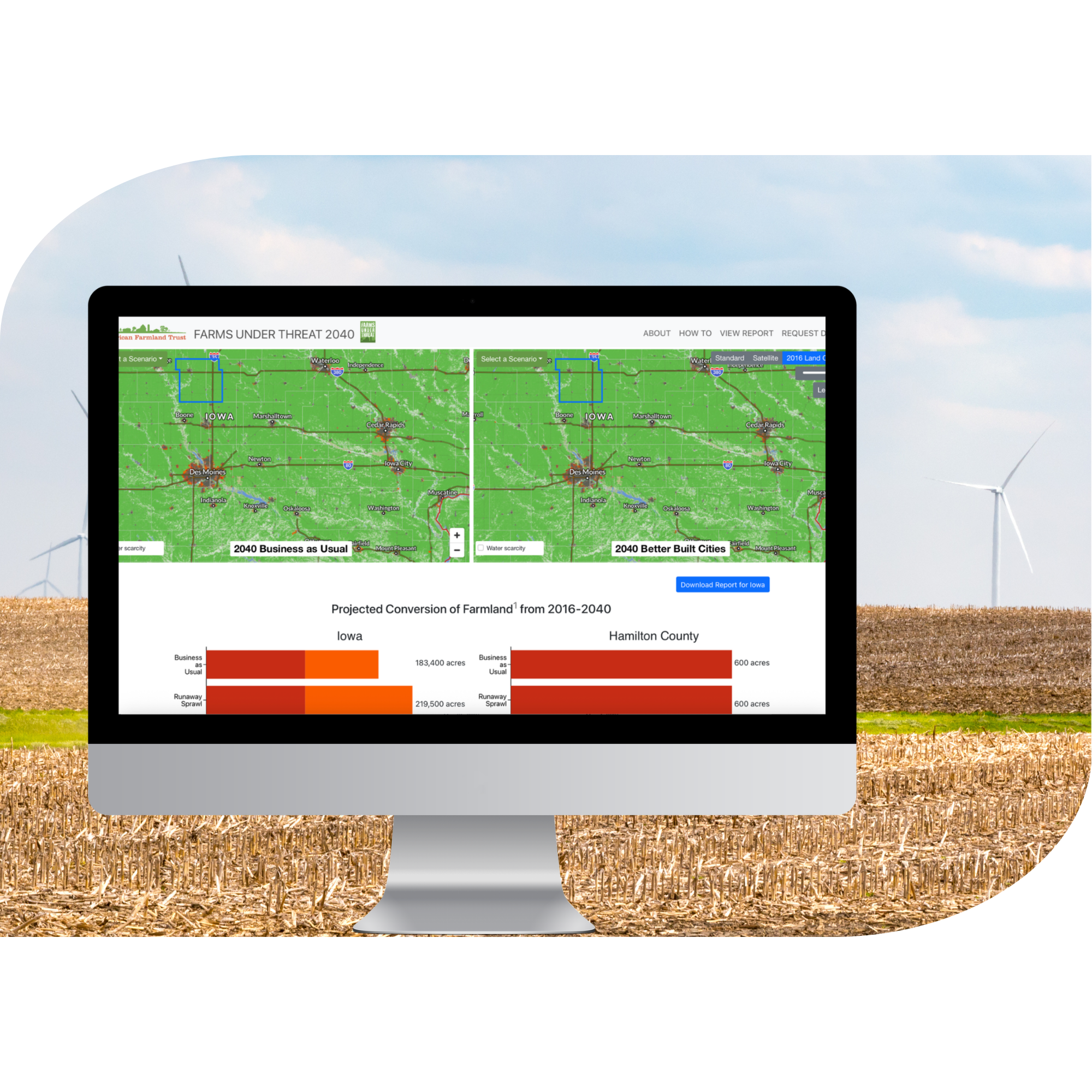
Within that parcel framework, the team integrated satellite imagery, zoning, land use, and infrastructure data. They then simulated development under two scenarios. One reflected continued sprawl. The other reflected smarter growth patterns.
This allowed the researchers to see which properties were most likely to face development pressure, and which farmland acres could potentially be preserved through better planning.
For public agencies, land trusts, agricultural organizations, and policy teams, this is the level of detail needed for decision support. Regrid helped connect national-scale analysis to the real properties where land use decisions happen.
THE RESULTS
The model revealed that, if current sprawl trends continue, more than 24 million acres of farmland could be lost by 2040.
It also showed that smart-growth strategies could save 18 million of those acres.
Because the analysis was parcel-specific, the results are immediately useful for local planning and conservation strategy. Planners and policymakers can see which properties are at risk, compare development scenarios, and focus protection efforts where they can have the greatest impact.
For conservation groups, the model helps prioritize vulnerable working lands. For public agencies, it supports more informed growth planning. For agricultural and rural policy leaders, it links land use decisions to food security, climate resilience, and rural economic goals.
“Regrid’s parcel data has been instrumental in helping us translate diverse data into property-level insights at the scales that matter for decision making.”
- Tyler Lark