



.png)




.svg)


.png)
















.png)



.png)
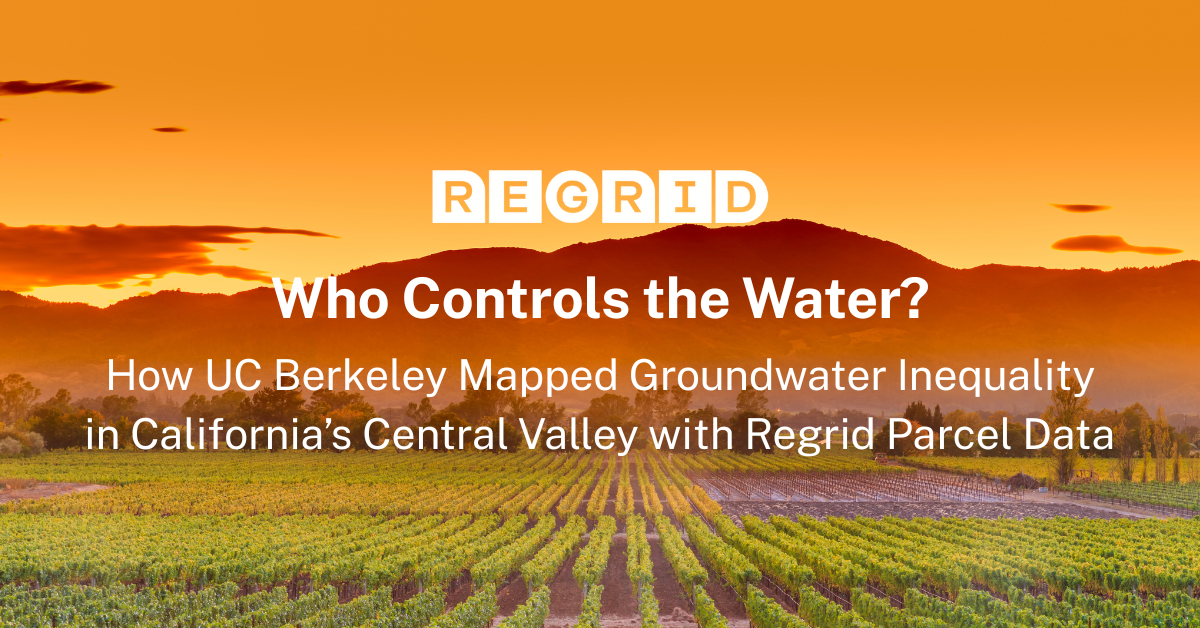
Who Controls The Water?
How UC Berkeley Mapped Groundwater Inequality with Regrid Parcel Data
Access to land and access to water have always been intertwined in California’s Central Valley — but until recently, no one could quantify exactly how.
That changed when researchers from UC Berkeley’s Department of Environmental Science, Policy, & Management department set out to understand the connection between cropland ownership and groundwater access across one of the most productive agricultural regions in the world.
Their goal was simple but ambitious: build the first owner-level dataset showing how land and water are distributed, and how those patterns might shape California’s new era of groundwater regulation under the Sustainable Groundwater Management Act (SGMA).
A Problem of Missing Data
Before they could measure inequality, the UC Berkeley team first had to answer a basic question: who owns which wells?
That proved harder than expected.
Public well records listed depths and general locations, but they did not include owner names. Many coordinates were only approximate — often mapped to the center of a square-mile Public Land Survey System (PLSS) section rather than to the actual well.
County parcel records weren’t a workable alternative. Every county maintained its own formats, fields, and update cycles, leaving no consistent way to connect wells, parcels, and owners across 19 different jurisdictions.
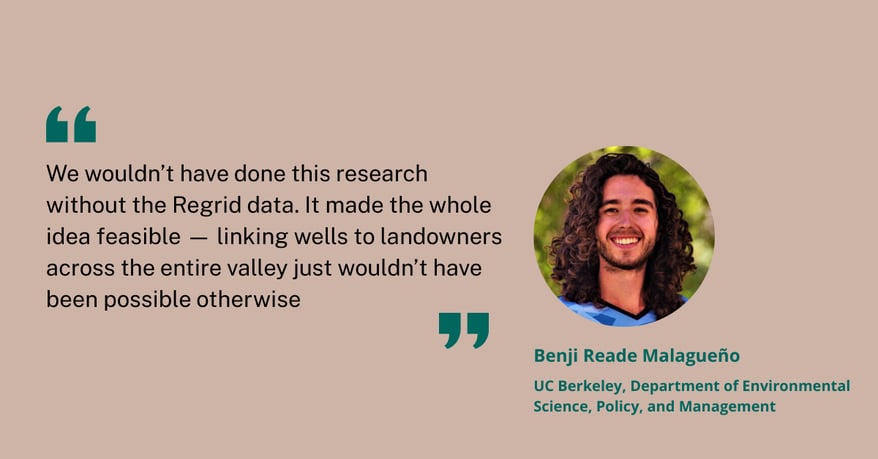
“We needed the owner information. In theory, it’s public, but nothing is standardized across counties — it would have been a huge amount of work to pull together.”
— Benji Reade Malagueño, UC Berkeley
The Regrid Solution
Through Regrid’s Data With Purpose (DWP) program, the team received standardized parcel data for the entire Central Valley — complete with geometry, APNs, owner fields, and addresses. Delivered as a bulk dataset and processed in RStudio, Regrid’s data enabled the researchers to link 12,000 groundwater wells to more than 10,000 cropland parcels and group them by owner.
“This project really came about because one of our colleagues discovered the Regrid data. Once we saw what was possible, everything followed from there.”
By combining Regrid parcel attributes with public well data, the team could measure inequality at an unprecedented level of detail — something that had never been done before for groundwater in California.
What the Research Found
The results told a powerful story: the top 10% of well owners control 46% of total groundwater capacity, and the top 1% of landholders own nearly a third of all cropland. Larger farms tend to drill deeper and higher-capacity wells, giving them far greater resilience during droughts than smaller operations.
“If there’s already high existing inequality and that becomes the baseline for allocating groundwater, it could have disproportionate impacts on smaller and more marginalized farmers.”
The study establishes a defensible baseline for equity — a way to track how access to land and water shifts as SGMA policies take effect.
Broader Impact
The findings have already sparked conversations well beyond academia.
UC Berkeley’s team has presented through the Berkeley Food Institute and is collaborating with the L.A. Times on a feature story that will bring these issues to a wider public audience.
Organizations such as the Community Alliance with Family Farmers are exploring how to use the data to support their advocacy and policy work.
Why it Matters
The project proves that with the right data foundation, complex ownership questions can be answered at scale. Not just for groundwater but for any issue where land, infrastructure, and equity intersect.
Regrid’s standardized parcel data enables repeatable methods and scalable analysis for researchers, enterprises, and public agencies alike.
Learn More
We believe that great data should never be out of reach for the organizations and individuals working to make a difference. Regrid's Data With Purpose program supports universities and nonprofits that use parcel data for research and social impact, tailored to specific budgets.
We’re here to support the important work you do with fast and flexible data.
Learn more about Data With Purpose or fill out an application with your project needs at regrid.com/purpose
References
Malagueño, B. R., Marston, L., Dobbin, K., Rempel, J., Schantz, M., Waqar, M., & D’Odorico, P. (2025). Connecting inequalities in land ownership and groundwater access: the case of California’s Central Valley. Environmental Research Letters, 20(9), 094026
