





.png)





.svg)


.png)




















.png)



.png)

Mapping America’s Agricultural Future
How Farms Under Threat 2040 Uses Parcel Data to Show What’s at Stake
By 2040, millions of acres of America’s farmland could be lost—not to disaster, but to development. Where that loss occurs, and how it can be avoided, is the focus of Farms Under Threat 2040, a national land-use model developed by the University of Wisconsin’s SAGE Lab and commissioned by the American Farmland Trust (AFT).
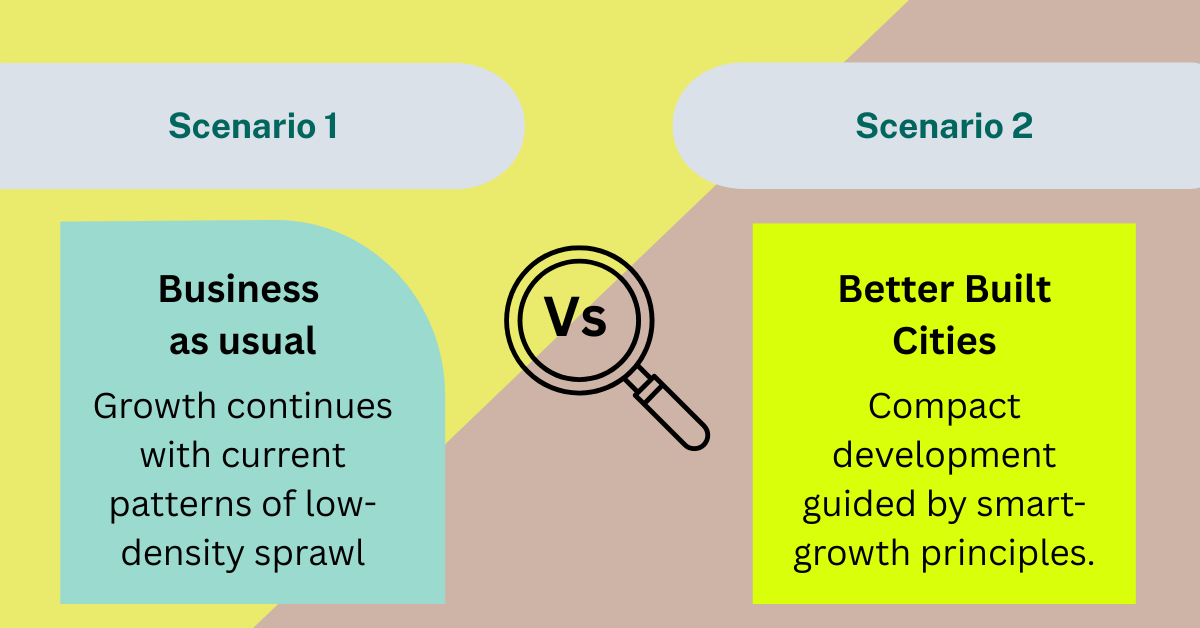
This study forecasts which farmland parcels are most at risk of conversion under two different scenarios: one where current sprawling development patterns continue, and another where compact, smart-growth strategies are adopted.
The difference is stark. Without intervention, 24 million acres of farmland and open space could be lost by 2040. But with smarter planning, 18 million of those acres could be saved.
This wasn’t a general estimate—it was parcel-specific. That level of precision made it useful for local action.
Agricultural land is disappearing fast
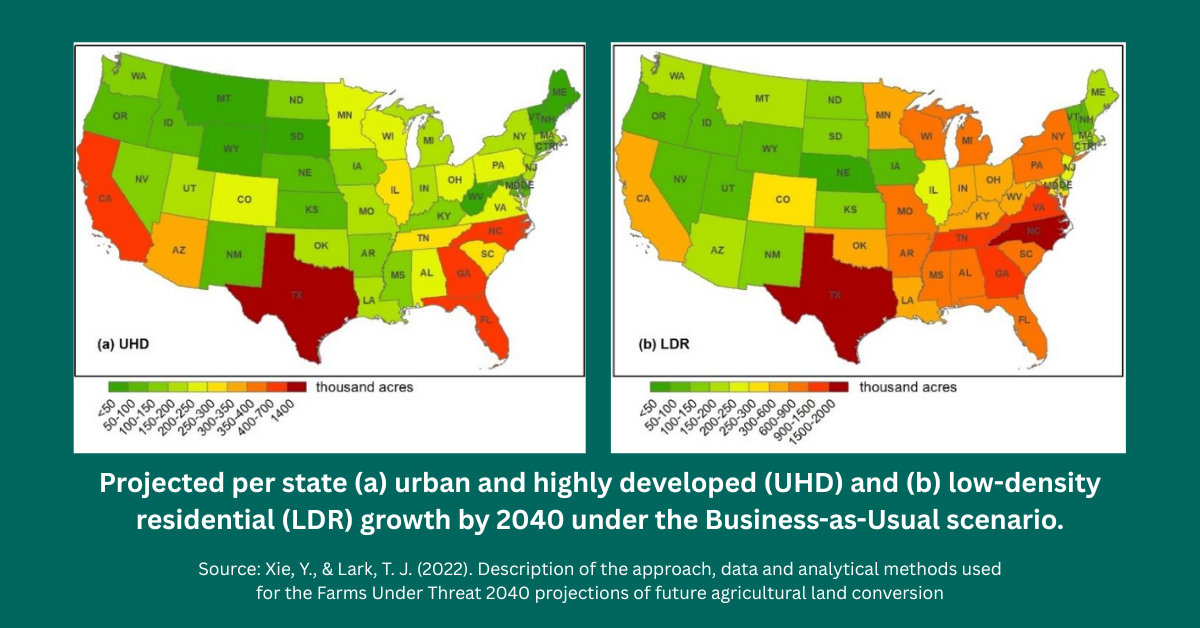
The U.S. is losing agricultural land every year to residential, commercial, and infrastructure growth. Some of this is inevitable—but much of it is inefficient, low-density sprawl that fragments landscapes and undermines rural economies.
The problem isn’t just the loss of open space, it’s the erosion of the food system, rural economies, and climate resilience. Once prime farmland is paved over, it doesn’t come back.
Most land-use forecasts fail to pinpoint exactly where that change will happen. They show regional patterns, but not which specific properties are most vulnerable. Farms Under Threat 2040 set out to model those risks at the scale that matters—parcel by parcel—so planners, policymakers, and communities can act before land is lost.
What would smarter growth actually save?
Using advanced modeling and national datasets, the research team simulated how land development might unfold under two scenarios:
- Business as Usual: Growth continues with current patterns of low-density sprawl.
- Better Built Cities: Compact development guided by smart-growth principles.
Regrid made parcel-level forecasting possible
To root their analysis in the real world, the team used Regrid’s nationwide parcel dataset—covering over 150 million properties across the U.S. This data gave them the uniform spatial framework needed to integrate land use, development pressure, and zoning data across jurisdictions.
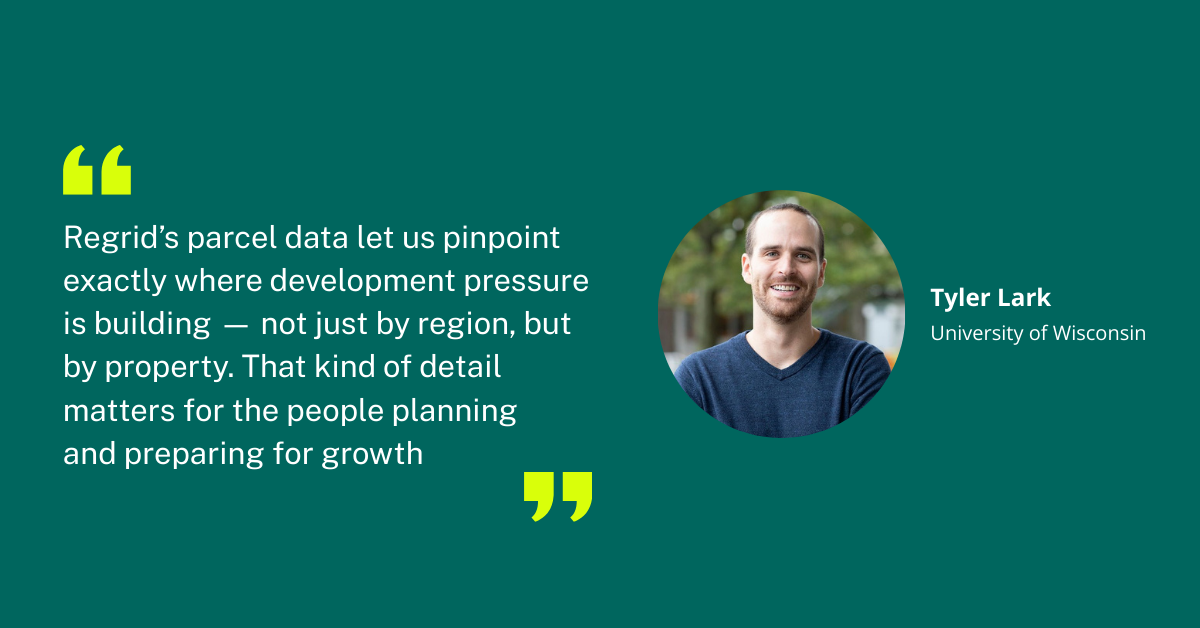
“Regrid’s parcel data let us pinpoint exactly where development pressure is building — not just by region, but by property. That kind of detail matters for the people planning and preparing for growth” says Tyler Lark of the University of Wisconsin.
With Regrid’s schema in place, the researchers could align satellite analyses and infrastructure proximity models with ownership boundaries—producing results that could be understood, validated, and used by practitioners.
Lark reiterates “Regrid's parcel data helps us go beyond pixels and points on a map to better understand the real things we care about, like people, and how they're affected by changes to properties.”
Without a consistent, scalable parcel layer, modeling this wouldn’t have been feasible.
This enabled development vulnerability to be measured and mapped
With Regrid’s data as the spatial backbone, the team identified which parcels were most at risk of conversion—and which would remain undeveloped under smart growth strategies.
“Using Regrid’s parcel data, we were able to identify which specific properties were most likely to remain undeveloped under smart growth scenarios. That made it possible to estimate the benefits at the parcel level” says Lark.
Those insights are now available through an interactive web tool that allows users to explore land-use vulnerability and resilience under different policy and planning futures.
With this level of spatial insight, stakeholders can:
- Target land protection where it will have the most impact
- Guide development toward lower-impact areas
- Align policies with climate and food security goals
- Make investments that protect both rural economies and ecological systems
Land use planning must evolve
The Farms Under Threat 2040 project isn’t just a model—it’s a decision-support tool. With parcel-level clarity, it enables:
- Planners to anticipate where growth should and shouldn’t go
- Conservation groups to prioritize at-risk lands
- Policy leaders to align land use with food security, resilience, and equity goals
Lark says “Regrid's parcel data has been instrumental in helping us translate diverse data into property-level insights at the scales that matter for decision making.”
In an era defined by climate urgency, food system stress, and housing pressure, tools like Farms Under Threat 2040 show what’s possible when big-picture models are grounded in real-world geography.
This project is more than a warning—it’s a blueprint. With the right policies, incentives, and data, millions of acres of farmland can still be preserved. And with Regrid’s parcel fabric, they now have the spatial infrastructure to do it.
Learn more about Regrid's Data With Purpose program to help fund your parcel project efforts at regrid.com/purpose
